


 Chirurgie
  Treatment by our surgeon
Anesthesia
Twilight sleep

Downtime
3-7 days / 1 week compression bandage / 2 weeks no sport
Rates
-
Gynecomastia surgery 4'900 CHF
Price list indicative and valid as of September 1, 2024.
Discounts subject to conditions, cannot be combined with other offers or subscriptions.
Payment in instalments in collaboration with Swissbilling, subject to their approval and available in clinics only.
Treatments
Further information
All medical treatments require prior consultation. A personalized estimate can be drawn up following this consultation.
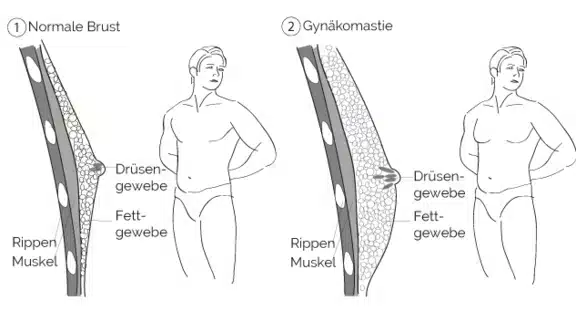
Many men suffer from so-called gynecomastia (male breast enlargement). This is a benign enlargement of the male mammary gland or glandular body on one or both sides. The exact causes cannot always be determined. However, the intake of certain medications or the excessive use of anabolic steroids, cannabis and alcohol can be responsible for its development. Gynecomastia is not considered a disease in its own right, but a symptom that may indicate a hormonal disorder. On the other hand, there is pseudogynecomastia with no further pathological value.
Experts estimate that almost every second man has gynecomastia (male breasts). And for many of them, this male breast development has a negative impact on their self-confidence, especially if the disorder cannot be controlled by exercise or a targeted diet. In such cases, breast reduction or gynecomastia treatment can help.
Advantages of gynecomastia treatment at the prevention center
- Years of experience in the treatment of gynecomastia
- In-depth consultation & planning of the surgery
- Customized treatment techniques for natural results
- Treatment under local anesthesia possible
- Incision with as few scars as possible
- Hygiene and quality standards at the highest level
Goals of gynecomastia treatment
In the case of gynecomastia, the breasts can be reduced in size and their appearance improved with a special treatment. The result, a smaller and more masculine breast, is usually very satisfying for the treated men and is generally permanent. The mammary glands only enlarge again in rare cases.
Treatment methods
There are basically two common treatment methods for gynecomastia: one is liposuction. This method usually achieves very good results with very fatty breast tissue. This involves making barely visible skin incisions around the nipples and armpits. The doctor then uses a thin cannula to suck out the excess fat and glandular tissue in the breast area. Liposuction can be performed on an outpatient basis and under local anesthesia. If the man is only given a local anaesthetic, he is given an additional sedative either in the form of a tablet or as an intravenous injection. This induces a kind of twilight sleep. This means that the man is awake but insensitive to pain.
In men with significantly enlarged breasts, however, the excess glandular tissue is usually removed directly. It may sometimes be necessary to remove excess skin. In these cases, a small incision is made at the edge of the nipple.
Excess tissue also occasionally has to be removed during liposuction, but only if the skin does not contract to the expected extent.
Before gynecomastia treatment
Before treatment, a urological examination of the testicles and chest should be carried out, especially in the case of unilateral problems. In addition, the lungs are x-rayed and the chest and upper abdominal area are examined by ultrasound. Breast cancer screening, on the other hand, is rather rare. A blood test to determine the hormone status and liver values is also part of the routine.
The gynecomastia treatment
If gynecomastia (male breast) occurs due to a significant increase in mammary gland tissue, this is usually removed directly through an incision in or at the edge of the nipple. Excess fat and possibly also excess skin is usually removed in conjunction with this. To contour the breast, additional
liposuction
can also be performed. The cannulas required for this are usually inserted through the already opened areas or in the area of the lateral underbust crease or the armpit.
If the problem mainly consists of excess fatty tissue, this is usually corrected exclusively by liposuction. The cannulas are inserted at the points described above. In a few cases, a tightening of the breast skin is necessary following breast reduction in order to achieve an appropriate result.
Gynecomastia treatment at the prevention-center Zurich
Gynecomastia surgery is performed in our operating rooms at Utoschloss Zurich. The consultation before the procedure takes place either on the premises of the prevention-center Zurich.
Gynecomastia: Aftercare
As a rule, an elastic compression bandage is applied during the procedure to treat gynecomastia and should be worn consistently for two weeks after the treatment. This is the only way to optimally support the reduction in swelling, wound healing and skin shrinkage.
Light physical activities can usually be resumed after just a few days. Experience has shown that the chest area still feels a little unfamiliar during this time. If you work mainly in a sitting position, you can usually return to your job after three to seven days. Physically strenuous activities should be postponed for two to three weeks. To prevent pigmentation disorders, direct sunlight in the chest area should be avoided for the first six months. Sports activities (especially lifting, pulling and pushing) should be avoided for at least four weeks.
Risks & side effects
Overall, breast reduction surgery has very few complications and can be performed with a high degree of efficiency and safety. Despite the utmost care, however, there have been isolated cases of scarring, changes in the color of the skin in the breast area, relief deformations of the breast or asymmetry of the nipples. However, these undesirable changes can usually be corrected with special follow-up treatments.
Residual swelling in the breast area, on the other hand, is relatively common, but usually subsides after about three to six months.
Frequently asked questions about gynecomastia surgery
General information on gynecomastia surgery
What is gynecomastia?
Gynecomastia is the development of breasts in men. The affected male breast can vary from an enlarged glandular body to the formation of a complete breast. In some cases, the male breast is also asymmetrical.
How do you recognize gynecomastia?
Gynecomastia is the enlargement of the mammary gland in men. This often causes the breasts to enlarge and in some cases appear feminine. Gynecomastia can often occur during puberty as a result of hormonal changes. Adolescents who suspect gynecomastia should consult an endocrinologist who can examine their breasts and hormone levels. Men who later suffer from enlarged breasts can consult a specialist for primary clarification (laboratory, ultrasound, medical history), who can examine the breasts using modern diagnostic procedures.
When can gynecomastia occur?
Gynecomastia is independent of age and can occur in very young men. It can be caused by poor nutrition and the associated hormonal imbalances or medication abuse. Gynecomastia can also occur in old age due to increased fat accumulation or an increased oestrogen level.
What can you do about gynecomastia?
If gynecomastia has been diagnosed, various treatment measures can be taken. If the gynecomastia is hormonal, it can be counteracted with certain medications. Men for whom such therapy is not an option or does not work can undergo surgical removal of the mammary gland and excess fatty tissue. The mammary gland is permanently removed as part of this procedure so that no more excess tissue can be produced and the breast appears smaller and masculine again.
What scars occur during gynecomastia surgery?
Gynecomastia surgery usually only requires a small incision to remove fat and glands. This tiny incision is usually made on the nipple so that the scar is not actually visible later. If the gynecomastia is so pronounced that the liposuction results in excess skin, which also needs to be tightened, an additional scar on the breast is necessary. At our clinic, we make sure that the incision is particularly sparing and invisible, so that you benefit from a virtually scar-free breast later on!
Can gynecomastia recur after surgery?
In order to prevent gynecomastia from recurring after surgery, hormonal causes should first be investigated endocrinologically. If the enlarged breast is not hormonal, surgical removal is the appropriate treatment method. Once a mammary gland has been removed and tissue removed, it can reappear in rare cases. Occasionally, remnants of the gland may remain in the breast, but these can be easily removed in a short follow-up procedure.
What are the risks of gynecomastia surgery?
The risks of gynecomastia surgery do not differ from the classic surgical risks. In rare cases, thinning of the skin or necrosis may occur. The sensation in the treatment area may change slightly at first, but usually regulates itself again within the first few months. Unevenness may occur after liposuction or the glandular body may grow back after the operation, but this can be counteracted with an uncomplicated follow-up treatment.
Procedure for gynecomastia surgery
What does the procedure look like?
The treatment of gynecomastia involves removing the enlarged glandular body. This can be completely removed via a small incision at the edge of the nipple. Excess fatty tissue can also be removed via two small incisions made on the ribcage. The fatty tissue is then suctioned out through these incisions after it has been anaesthetized in advance with a diluted local anaesthetic.
Is gynecomastia surgery painful?
There is usually no pain during gynecomastia surgery. There is a feeling of tension and slight muscle soreness. We also follow up with antibiotics and painkillers so that gynecomastia surgery is generally not very unpleasant.
Is general anesthesia used for gynecomastia surgery?
For gynecomastia surgery, we usually use a twilight sedation so that the client is not aware of the operation. Men have firmer skin and tighter connective tissue, which means that liposuction can be somewhat uncomfortable. We want to avoid this by using twilight sleep.
Aftercare for gynecomastia surgery
What do I need to consider after gynecomastia surgery?
After the operation, it is important to rest for two to three days and wear the chest band for a week. Sport should be avoided for 2 weeks. Our customers should take the prescribed medication conscientiously and at best elevate their upper body slightly.
When are you socially acceptable again after gynecomastia surgery?
After gynecomastia surgery, you should take a few days to recover and rest the treatment area. Depending on your recovery and the extent of the treatment, you will be fit for social life again after 3 to 7 days.
When can I do sports again after gynecomastia surgery?
After gynecomastia surgery, sports should be avoided for 2 weeks.
Can I go home immediately after the operation?
Gynecomastia surgery takes about an hour and is performed on an outpatient basis, so that our clients can leave the clinic immediately afterwards.
Does health insurance cover the costs of gynecomastia surgery?
The costs of gynecomastia treatment are normally not covered or only partially covered by health insurance.


